 Label Bas Carbone
Examples: reducing the frequency of soil cultivation, minimalist plot preparation, restoring organic matter and preserving soil microfauna.

Examples: diversity and locality of crop species, preservation of habitat for local flora and fauna, presence of beehives for pollination.

Examples: territorial dynamics, societal demand, diversification of the activity, local sales/processing, working conditions, sharing of good practices.

Examples: Consideration of wetlands, use of adapted species, drip-connected irrigation tools.
Planting an organic pear orchard in Calvados
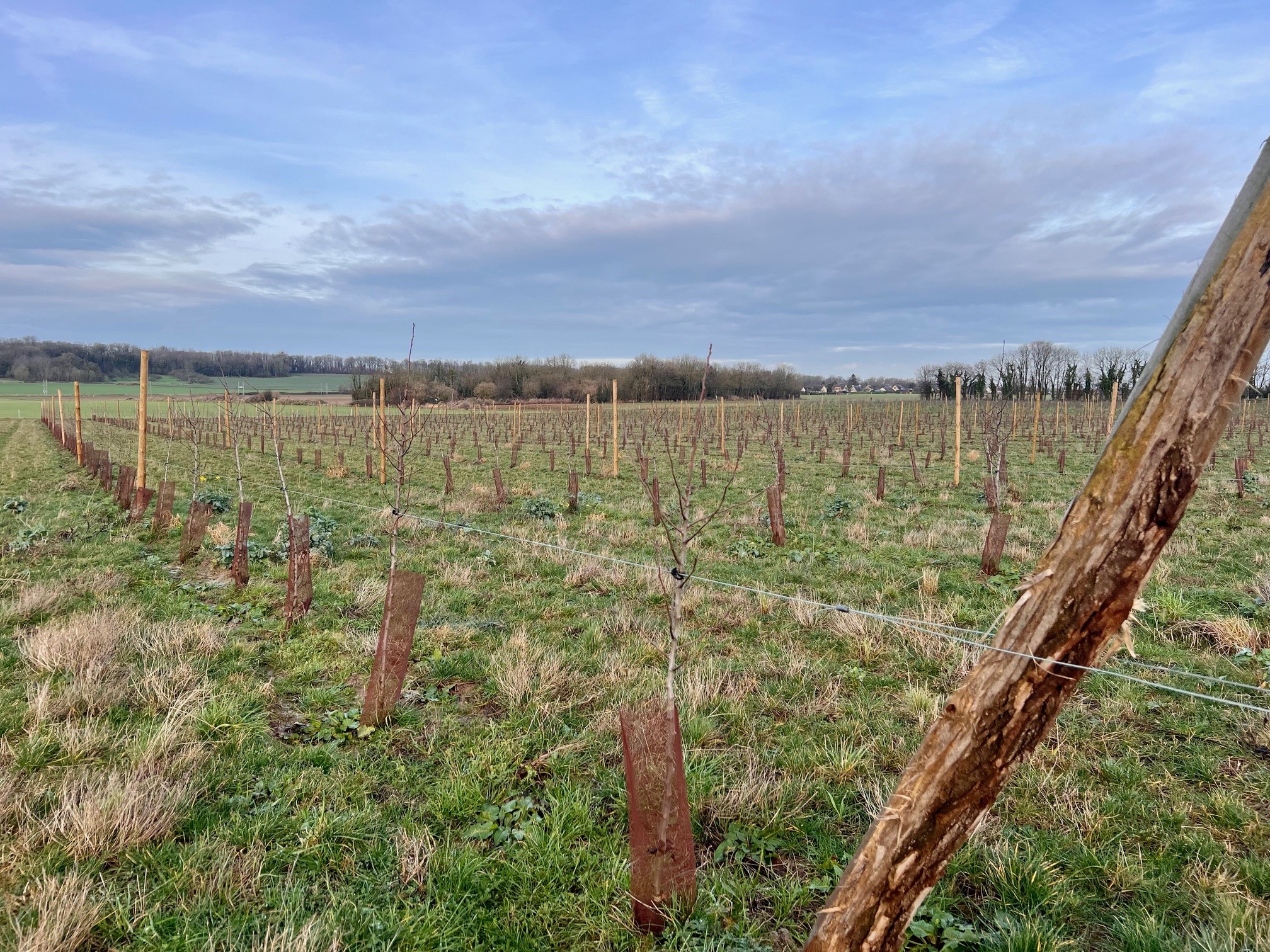
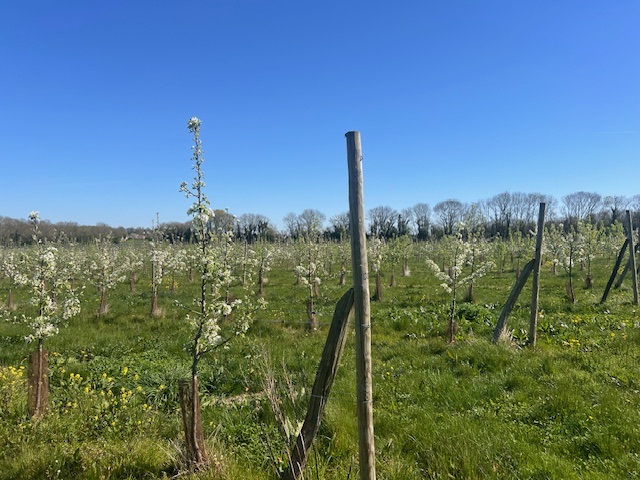
This project consists of planting a new 2.7ha plot of organic pear orchards. This plot was previously used for annual crops such as cereals. This will allow to store 167,11 Tons of CO2 equivalent in 20 years*.The Domaine de la Flaguerie (originally Les Vergers de Ducy) is a farm in Bessin which transforms its production of apples and pears on site into cider, pommeau, calvados, perry or other traditional alcohols and liqueurs. Administered by Norman enthusiasts, its core business is devoted to the production and processing of cider apples and pears. The farm practices organic and reasoned agriculture, and develops short distribution circuits. The orchards have long been certified AB Agriculture Biologique.
A family story
It was in 1835 that the family moved to the Domaine de la Flaguerie. The estate then includes the manor and two farms. The meadows are planted with tall apple trees under which Normandy cows graze. The apples collected in the fall are used to produce an artisanal cider which is the essential drink of Norman farmers. The cider from the previous year is distilled in a rudimentary way and produces Calvados. At the time, and until the 1960s, it was common to add this Calvados to morning coffee.
In 1990, Mathilde and René Petrich decided to dedicate the Estate to the cultivation of cider apples and planted a 20-hectare orchard of low-stem apple trees. This is the start of the adventure. Very quickly, the choice of Organic Agriculture is essential, corresponding to the values of the family, close to the earth, close to nature. The farm will then diversify with the cultivation of pears. Each year brings a new challenge and consolidates the know-how acquired.
The processing and bottling is done at the farm, which favors short circuits and therefore a low carbon footprint. In addition, the planting of permanent trees will allow more CO2 to be sequestered throughout the year compared to an annual crop, thanks to the soil which will no longer be worked each year. Finally, the orchards of the farm being certified "Organic Agriculture" since 1998, this new plantation will require little fertilizer and treatment compared to previous crops and only natural inputs are authorized. This new cultural itinerary will contribute to avoiding emissions and makes the project even more virtuous.
* The final value of the estimate will only be established after verification by an independent auditor and an administrative verification decision.
 Label Bas Carbone
Examples: reducing the frequency of soil cultivation, minimalist plot preparation, restoring organic matter and preserving soil microfauna.
Examples: diversity and locality of crop species, preservation of habitat for local flora and fauna, presence of beehives for pollination.
Examples: territorial dynamics, societal demand, diversification of the activity, local sales/processing, working conditions, sharing of good practices.
Examples: Consideration of wetlands, use of adapted species, drip-connected irrigation tools.
Planting an organic pear orchard in Calvados
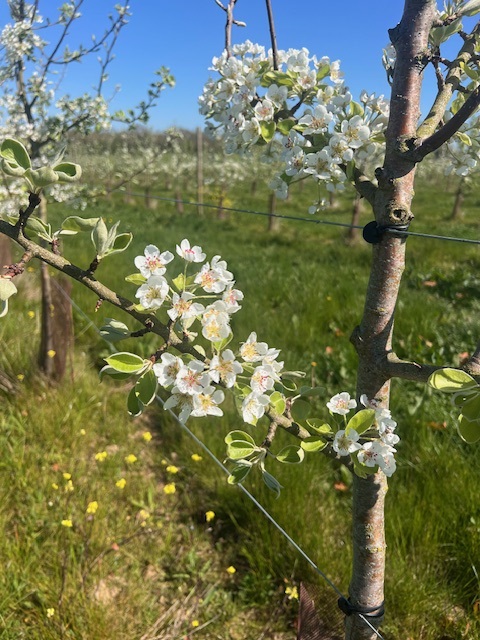
This project consists of planting a new 2.7ha plot of organic pear orchards. This plot was previously used for annual crops such as cereals. This will allow to store 167,11 Tons of CO2 equivalent in 20 years*.The Domaine de la Flaguerie (originally Les Vergers de Ducy) is a farm in Bessin which transforms its production of apples and pears on site into cider, pommeau, calvados, perry or other traditional alcohols and liqueurs. Administered by Norman enthusiasts, its core business is devoted to the production and processing of cider apples and pears. The farm practices organic and reasoned agriculture, and develops short distribution circuits. The orchards have long been certified AB Agriculture Biologique.
A family story
It was in 1835 that the family moved to the Domaine de la Flaguerie. The estate then includes the manor and two farms. The meadows are planted with tall apple trees under which Normandy cows graze. The apples collected in the fall are used to produce an artisanal cider which is the essential drink of Norman farmers. The cider from the previous year is distilled in a rudimentary way and produces Calvados. At the time, and until the 1960s, it was common to add this Calvados to morning coffee.
In 1990, Mathilde and René Petrich decided to dedicate the Estate to the cultivation of cider apples and planted a 20-hectare orchard of low-stem apple trees. This is the start of the adventure. Very quickly, the choice of Organic Agriculture is essential, corresponding to the values of the family, close to the earth, close to nature. The farm will then diversify with the cultivation of pears. Each year brings a new challenge and consolidates the know-how acquired.
The processing and bottling is done at the farm, which favors short circuits and therefore a low carbon footprint. In addition, the planting of permanent trees will allow more CO2 to be sequestered throughout the year compared to an annual crop, thanks to the soil which will no longer be worked each year. Finally, the orchards of the farm being certified "Organic Agriculture" since 1998, this new plantation will require little fertilizer and treatment compared to previous crops and only natural inputs are authorized. This new cultural itinerary will contribute to avoiding emissions and makes the project even more virtuous.
* The final value of the estimate will only be established after verification by an independent auditor and an administrative verification decision.