 Vinéa Energie
Examples: territorial dynamics, societal demand, diversification of the activity, local sales/processing, working conditions, sharing of good practices.

Examples: reduction of energy consumption of mobile and stationary installations, reduction of journeys, on-site energy production.
Vinea Énergie sees the vine beyond its status as an agricultural crop: it is a renewable resource, a source of ecological energy and a pillar of the circular economy.
Read moreEnergy recovery from vine stocks in Gironde
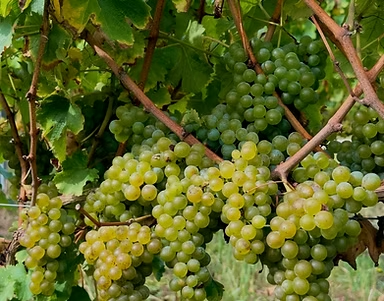
Château Shuette, located at 37 Chemin du Caderot in Saint-Loubès (33450), is a family-run wine estate known for its commitment to regenerative agriculture and the production of natural wines.
Founded in 2020, the estate is the vision of Shu Ho and Ian Hocking, who fully took over the vineyard's operations in December 2022. Their mission is to prove that diversified, organic, and regenerative farming can thrive in the Bordeaux region.
Terroir and Vineyard
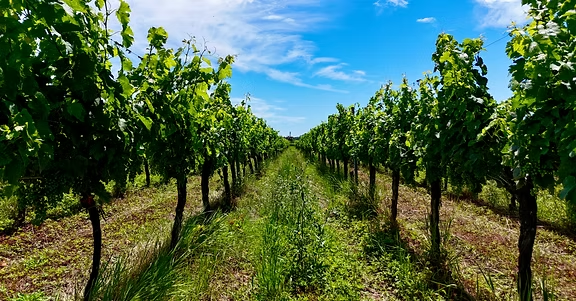
The vineyard spans 4.5 hectares in a single block, located next to the Dordogne River, on soils composed of deep clay and mineral-rich schist deposits.
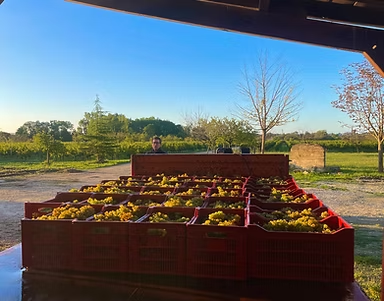
Organically farmed for nearly 30 years, the estate produces approximately 16,000 bottles annually. The grape varieties grown include Cabernet Sauvignon, Cabernet Franc, Cabernet Noir, Petit Verdot, Merlot, Sémillon, Sauvignon Blanc, and Malbec.
Sustainable Practices and Biodiversity
The estate integrates over 250 fruit trees (plum, cherry, apricot, apple, pear, peach, and nectarine) throughout the vineyard to provide habitat and food for local wildlife.
In addition, more than 280 nesting boxes for birds, bats, and owls have been installed, supporting biodiversity.
Cover crops and wildflowers are carefully selected to increase diversity, enhance soil biomass, and capture carbon and nitrogen—eliminating the need for synthetic fertilizers.
Wines and Winemaking
Château Shuette produces a range of natural wines with minimal intervention and very low levels of added sulfites throughout the winemaking process.
All vineyard work is done manually, with the goal of maximizing grape quality and expressing the true character of the terroir.
Wine Tourism Experiences
Visitors are invited to discover the estate through personalized guided tours, offering insight into the vineyard’s sustainable practices and tastings of wines made on-site.
Tastings are designed to highlight the unique features of each wine, often paired with local delicacies to enrich the experience.
At the heart of this project is the transformation of uprooted vines, traditionally considered as waste and burnt at the end of fields, into a renewable resource. Burning remains the simplest and most economical method, but a more virtuous alternative is possible thanks to the financing of the greenhouse gas emissions avoided.
This winegrowing operation is actively participating in this approach by recovering 12,3 tonnes of vines as part of this project, avoiding the emission of an estimated 12,72 TeqCO₂*.
1. Collection and sorting
The uprooted vines are collected from winegrowers in the area, particularly in Saint-Loubes. Selective sorting separates the different types of residue (stumps, stakes, wood markers) for further processing.
2. Transformation into biomass
The collected vines are taken to specialised facilities where they are processed into wood energy in the form of wood chips, which can be used as fuel for biomass boilers, producing heat and renewable electricity.
- To convert 12,3 tonnes of vines into a high added-value product.
- Optimise the management of vineyard residues by avoiding their simple disposal.
This project will enable the farm to become part of a circular economy in which uprooted vines become a useful resource serving the energy and agricultural transition.
Ecological : Avoiding open-air burning, limiting CO₂ emissions and atmospheric pollutants.
Economic and social : Development of an agricultural waste recycling industry, job creation and stimulation of the regional economy.
* The final value of the estimate will only be established after verification by an independent auditor and an administrative verification decision.
 Vinéa Energie
Examples: territorial dynamics, societal demand, diversification of the activity, local sales/processing, working conditions, sharing of good practices.
Examples: reduction of energy consumption of mobile and stationary installations, reduction of journeys, on-site energy production.
Vinea Énergie sees the vine beyond its status as an agricultural crop: it is a renewable resource, a source of ecological energy and a pillar of the circular economy.
Read moreEnergy recovery from vine stocks in Gironde
Château Shuette, located at 37 Chemin du Caderot in Saint-Loubès (33450), is a family-run wine estate known for its commitment to regenerative agriculture and the production of natural wines.
Founded in 2020, the estate is the vision of Shu Ho and Ian Hocking, who fully took over the vineyard's operations in December 2022. Their mission is to prove that diversified, organic, and regenerative farming can thrive in the Bordeaux region.
Terroir and Vineyard
The vineyard spans 4.5 hectares in a single block, located next to the Dordogne River, on soils composed of deep clay and mineral-rich schist deposits.
Organically farmed for nearly 30 years, the estate produces approximately 16,000 bottles annually. The grape varieties grown include Cabernet Sauvignon, Cabernet Franc, Cabernet Noir, Petit Verdot, Merlot, Sémillon, Sauvignon Blanc, and Malbec.
Sustainable Practices and Biodiversity
The estate integrates over 250 fruit trees (plum, cherry, apricot, apple, pear, peach, and nectarine) throughout the vineyard to provide habitat and food for local wildlife.
In addition, more than 280 nesting boxes for birds, bats, and owls have been installed, supporting biodiversity.
Cover crops and wildflowers are carefully selected to increase diversity, enhance soil biomass, and capture carbon and nitrogen—eliminating the need for synthetic fertilizers.
Wines and Winemaking
Château Shuette produces a range of natural wines with minimal intervention and very low levels of added sulfites throughout the winemaking process.
All vineyard work is done manually, with the goal of maximizing grape quality and expressing the true character of the terroir.
Wine Tourism Experiences
Visitors are invited to discover the estate through personalized guided tours, offering insight into the vineyard’s sustainable practices and tastings of wines made on-site.
Tastings are designed to highlight the unique features of each wine, often paired with local delicacies to enrich the experience.
At the heart of this project is the transformation of uprooted vines, traditionally considered as waste and burnt at the end of fields, into a renewable resource. Burning remains the simplest and most economical method, but a more virtuous alternative is possible thanks to the financing of the greenhouse gas emissions avoided.
This winegrowing operation is actively participating in this approach by recovering 12,3 tonnes of vines as part of this project, avoiding the emission of an estimated 12,72 TeqCO₂*.
1. Collection and sorting
The uprooted vines are collected from winegrowers in the area, particularly in Saint-Loubes. Selective sorting separates the different types of residue (stumps, stakes, wood markers) for further processing.
2. Transformation into biomass
The collected vines are taken to specialised facilities where they are processed into wood energy in the form of wood chips, which can be used as fuel for biomass boilers, producing heat and renewable electricity.
- To convert 12,3 tonnes of vines into a high added-value product.
- Optimise the management of vineyard residues by avoiding their simple disposal.
This project will enable the farm to become part of a circular economy in which uprooted vines become a useful resource serving the energy and agricultural transition.
Ecological : Avoiding open-air burning, limiting CO₂ emissions and atmospheric pollutants.
Economic and social : Development of an agricultural waste recycling industry, job creation and stimulation of the regional economy.
* The final value of the estimate will only be established after verification by an independent auditor and an administrative verification decision.